
Why Australia’s Housing Market Can Rise in 2026 (Even With Rate Uncertainty)
If interest rates are uncertain, a fair question is: why isn’t the housing market falling apart?
KPMG’s latest Residential Property Market Outlook argues the answer is simple: Australia’s core problem isn’t demand - it’s supply. When there aren’t enough homes available (or being built fast enough), prices can stay supported even when borrowing power is pressured.
KPMG’s January 2026 outlook forecasts national house values rising 7.7% in 2026 (and national unit values rising 7.1%), with the strongest growth expected in the smaller capitals - particularly Perth, Brisbane, Darwin and Adelaide.
This article breaks down what KPMG is forecasting, why the “affordable / entry-level” end of the market is expected to remain the most competitive, and what it means for buyers and investors making decisions in 2026.
What KPMG is forecasting for 2026
KPMG expects housing momentum to remain solid through 2026, forecasting:
National house values: +7.7% in 2026
National unit values: +7.1% in 2026
Where the strongest growth is expected
KPMG’s forecast calls out the smaller capitals as the likely outperformers:
Perth: +12.8%
Brisbane: +10.9%
Darwin: +10.5%
Adelaide: +8.2%
Meanwhile, Sydney, Melbourne, Hobart and Canberra are expected to see more moderate growth relative to the standout markets.
The key question: how can prices rise if rates are uncertain?
On 3 February 2026, the RBA lifted the cash rate by 25 basis points to 3.85%. That directly impacts borrowing power and household cashflow.
So why would values still rise?
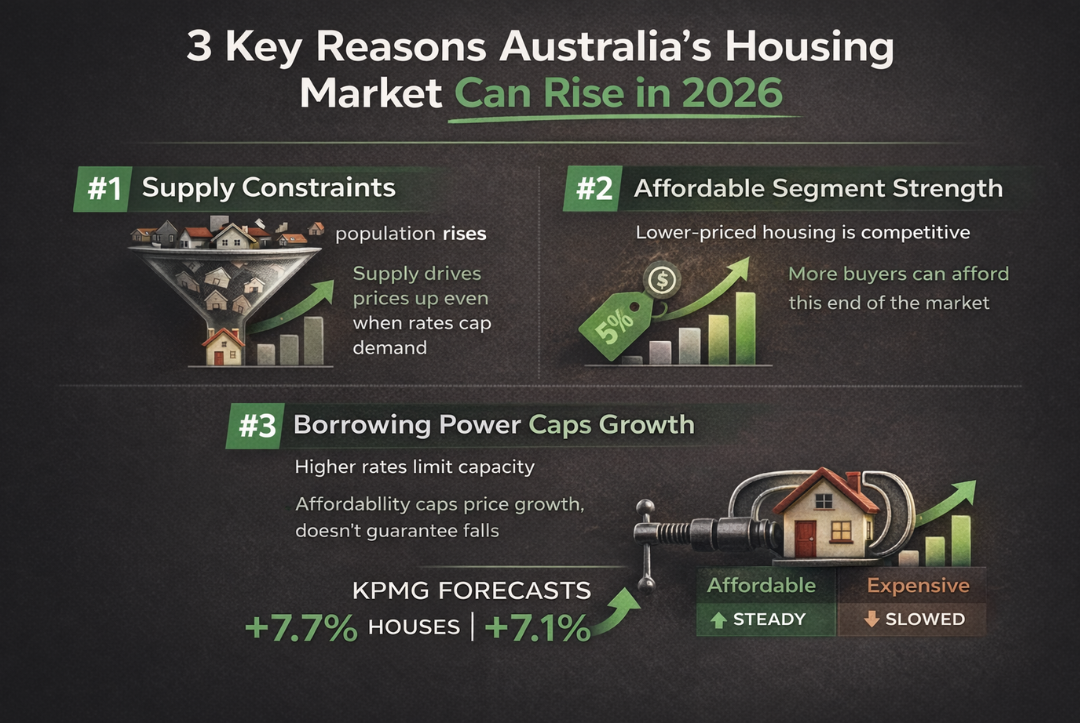
KPMG’s central argument is that supply tightness continues to underpin prices. In plain English: too many buyers and renters are chasing too few homes.
Why smaller capitals are expected to lead in 2026
KPMG’s forecast doesn’t just name the outperformers - it tells you what kind of conditions usually sit behind them.
Perth: forecast leader (+12.8%)
Perth topping the forecast list reflects a market where price momentum has been supported by affordability (relative to the east coast) and supply constraints. KPMG’s outlook explicitly expects Perth to be the national standout in 2026.
Brisbane (+10.9%) and Adelaide (+8.2%): strong demand meets limited stock
Brisbane and Adelaide are both forecast to post strong rises, which aligns with KPMG’s broader view that lower-priced markets/segments have more buyer participation and can keep moving despite rate uncertainty.
Darwin (+10.5%): smaller market, stronger swings
Darwin is forecast strongly as well - but as with any smaller capital, price moves can be more sensitive to local supply and demand shifts. KPMG’s forecast still puts Darwin in the top tier for 2026.
What this means for buyers and investors in 2026
1) Entry-level competition is likely to stay intense
If KPMG is right and the affordable segment outperforms, expect:
more competition for “good value” stock
fewer bargains at the bottom end
faster decision-making required on clean assets
2) The best strategy won’t be “pick the hottest city”
Forecasts are macro. Returns are micro.
In 2026, the gap between a great purchase and an average one is likely to come down to:
asset quality (layout, land component, scarcity, owner-occupier appeal)
location within the market (not just the city name)
holding costs and cashflow (rates, insurance, vacancy, strata/OC where relevant)
In a rate-uncertain year, buyers who rely on hype tend to overpay. Buyers who rely on fundamentals tend to win.
3) Sydney/Melbourne aren’t “bad” - they’re more selective
More moderate growth forecasts don’t mean “avoid.” They usually mean:
bargains come from negotiation and selectivity
A-grade scarcity stock can still hold up
compromised assets get punished (price reductions, longer days on market)
The bottom line
KPMG’s outlook is optimistic for 2026 because it expects supply tightness + resilient demand to outweigh rate uncertainty at a national level, with the strongest growth likely in smaller capitals and at the affordable end of the market.
But the real takeaway isn’t “buy anywhere in Perth/Brisbane/Darwin/Adelaide.”
It’s this:
In 2026, results will be driven less by hype and more by picking the right asset, in the right pocket, with a structure that holds up under rate pressure.