
Why Diversification Is Important To Your Property Portfolio.
Most investors say they want growth, cash flow, and stability.
Then they do the opposite: they buy everything in one city, one state, sometimes one suburb - and wonder why their portfolio stalls when that market goes flat, lending tightens, or rents stop moving.
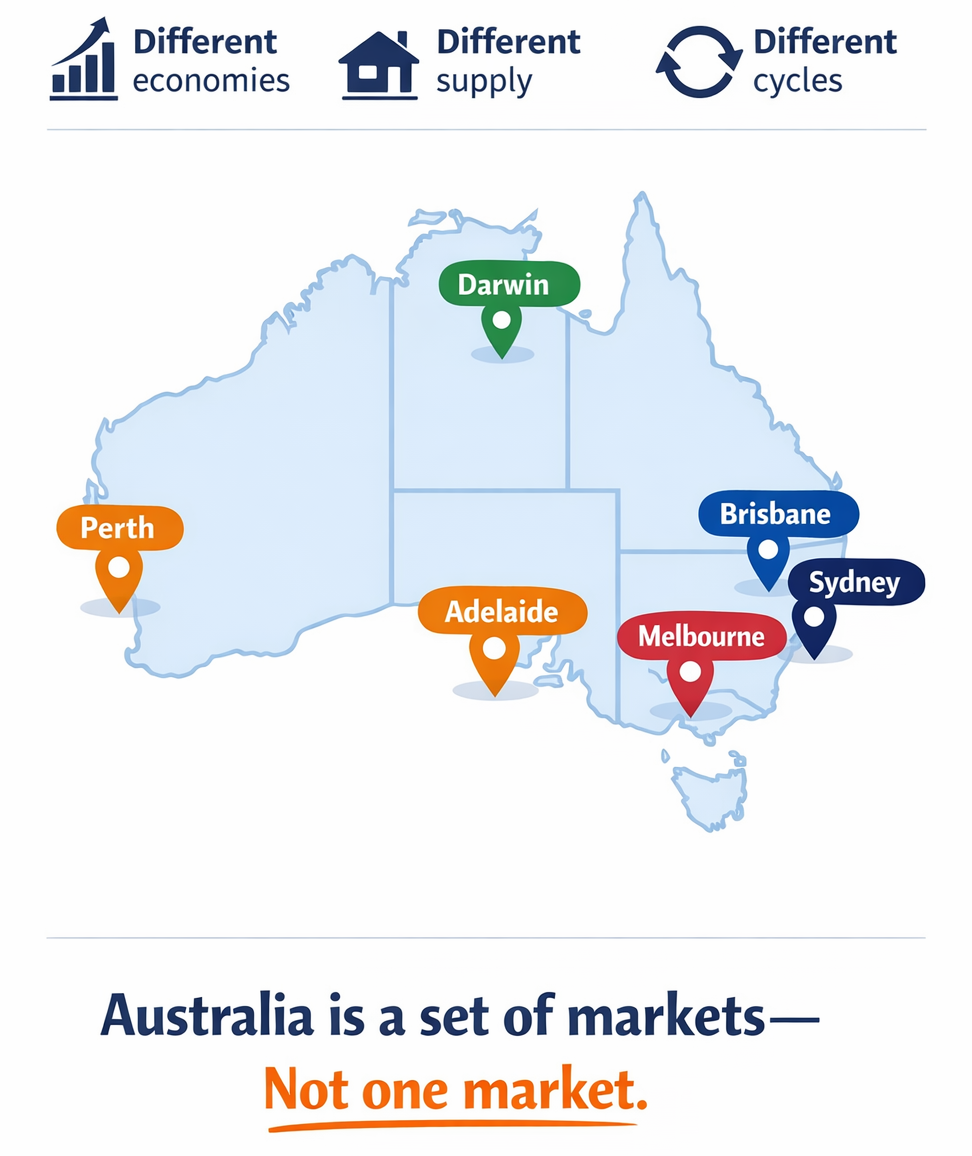
Australia is not one property market. It’s a bunch of different markets running on different clocks.
The real problem: “single-market bias”
If your whole portfolio is exposed to one city, you’re betting your entire outcome on:
one local economy
one migration trend
one supply pipeline
one set of state taxes and rules
one cycle (up, flat, down)
When that market cools, your portfolio cools with it - and your ability to keep buying slows down.
1) Markets don’t peak and trough together
You’re seeing it right now: smaller capitals have had stronger momentum while some larger markets have been softer. Even KPMG’s latest outlook expects stronger 2026 growth in several smaller capitals compared to the big two. KPMG projects national house prices +7.7% in 2026, with Perth (+12.8%), Brisbane (+10.9%), Darwin (+10.5%), and Adelaide (+8.2%) among the stronger forecasts.
At the same time, broader reporting on 2025 showed strong overall gains — but not evenly spread — reinforcing that “one-market thinking” is outdated.
What this means: if you only buy in one market, you’re stuck riding that market’s pace — even when better opportunities exist elsewhere.
2) Credit rules can change your buying power (and your local market might be the worst hit)
From 1 February 2026, APRA requires banks to limit new loans with DTI ≥ 6 to 20% of new lending (separately for owner-occupiers and investors).
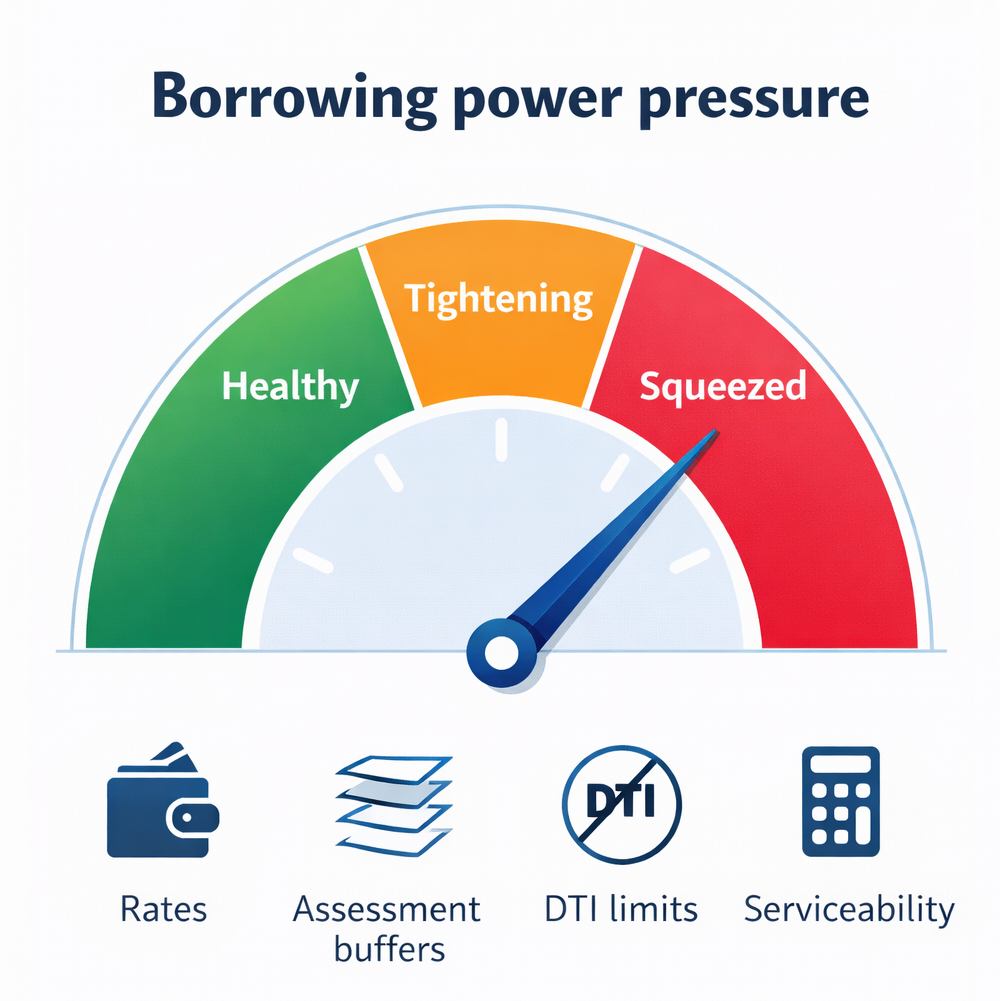
That matters because credit tightening doesn’t hit every market equally. When borrowing power gets squeezed, buyers tend to:
trade down in price
shift from houses to units/townhouses
chase more affordable markets where their approvals stretch further
If you’re only focused on one expensive market, you can get trapped: your clients want to buy, but the numbers don’t stack up anymore.
3) Population and rental pressure aren’t uniform
Housing demand follows people.
Australia’s population is still growing, supported by migration, even if levels fluctuate year to year. Australian Bureau of Statistics reported net overseas migration of 306,000 in 2024–25.
And at the state level, movement matters too. Queensland’s own population reporting shows net interstate migration contributing materially to population change (e.g., +24,015 over the 12 months to 31 March 2025).
Pair that with rental scarcity: multiple sources continue to describe vacancies as tight in several capitals (e.g., Perth around 0.7% and Adelaide around 0.9% in one January 2026 update).
You can also drill down suburb-by-suburb using SQM Research vacancy data.
What this means: if your one chosen market has easing rents or rising supply, your portfolio can underperform - even while another city is tightening and pushing rents up.
4) Diversification creates “more chances to win”
The biggest benefit of multiple markets is simple:
You stop needing one city to do all the heavy lifting.
Instead, you can build a portfolio where:
one market is your growth engine
another supports cash flow
another gives you value opportunities (buying well below comps)
another gives you timing (buying early in a cycle)
That’s how investors keep moving when one market goes quiet.
The catch: diversifying only works if you do it properly
Going interstate isn’t a flex - it’s a strategy. Done badly, it just increases risk.
Here’s the clean way to do it:
A simple “Core + Satellite” approach
Core market: where you know the streets, have your best networks, and can move fast.
Satellite markets: 1-2 additional cities you track continuously, ready to buy when conditions + pricing line up.
Not 6 cities. Not random buys. Just enough diversification to avoid being hostage to one market.
Your non-negotiables when buying outside your home market
Start with the asset type, not the city (owner-occupier appeal, scarcity, resale depth)
Run a supply check (construction pipeline + local stock profile)
Validate rental demand at suburb level (not city averages)
Buy on price discipline (comps, valuation support, exit liquidity)
Have local execution (PM, building/pest, conveyancer, boots-on-ground)
The blunt takeaway
If you only ever buy in one market, you’re accepting a single point of failure.
Diversification gives you:
more deal flow
better timing
less reliance on one cycle
a higher probability that something in your portfolio is outperforming at any given time
And in 2026 - with growth forecasts uneven across cities and lending rules tightening — being flexible is an advantage, not a nice-to-have.
Looking to assess your options and see what fits?
Click the link below to book in a FREE MEETING and our team will reach out to you!